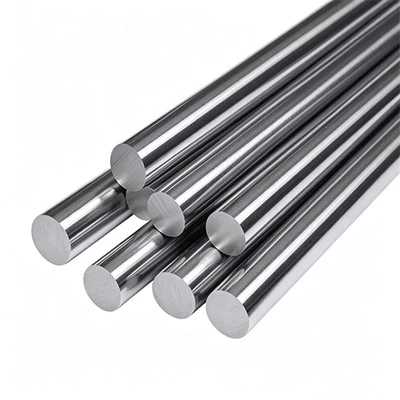


What it is
Long bone fractures. Femur. Tibia. Humerus. The bone breaks. Needs something down the middle to keep it straight.
Trauma surgery support titanium rod medical grade goes into the medullary canal. Intramedullary nail. Interlocking screws at both ends. The rod takes the load. The bone heals around it.
Car crashes. Falls. Sports injuries. Any high-energy trauma that splits a long bone.
Why titanium, not stainless
This comes up all the time. Patients ask. Surgeons have preferences. Here's what you need to know.
Stainless steel is stronger in raw numbers. Higher tensile. But it's also much stiffer. 200 GPa vs 110 GPa for titanium. Stiffer means more stress shielding. The bone gets weaker because the rod takes all the load.
Titanium's modulus is closer to bone. That matters for healing.
| Feature | Titanium (Grade 23) | Stainless Steel (316L) |
| Density (g/cm³) | 4.43 | 7.9 |
| Elastic modulus (GPa) | 110 | 200 |
| MRI artifact | Minimal | Significant |
| Nickel content | 0% | 10-14% |
| Corrosion in body | None | Possible over time |
For trauma surgery support titanium rod medical grade, most surgeons now choose titanium. Better bone biology. Better imaging. No nickel issues.
Material specifications
ASTM F136 is the medical standard for Ti-6Al-4V ELI. ELI means Extra Low Interstitial. Lower oxygen. Lower iron. Higher toughness than regular Grade 5.
| Property | Value |
| Standard | ASTM F136 / ISO 5832-3 |
| UNS Number | R56401 |
| Common name | Grade 23 |
| Tensile strength (min) | 860 MPa |
| Yield strength (min) | 795 MPa |
| Elongation (min) | 10% |
| Reduction of area (min) | 25% |
| Density | 4.43 g/cm³ |
| Elastic modulus | 110 GPa |
Chemical composition (max limits)
| Element | ASTM F136 |
| Oxygen | 0.13% |
| Iron | 0.25% |
| Carbon | 0.08% |
| Nitrogen | 0.05% |
| Hydrogen | 0.012% |
| Aluminum | 5.5 – 6.5% |
| Vanadium | 3.5 – 4.5% |
| Titanium | Balance |
ELI oxygen limit is 0.13%. Regular Grade 5 is 0.20%. That difference matters for toughness and fatigue life.
Common diameters for trauma rods
| Diameter | Bone | Typical use |
| 3.0 – 3.5mm | Humerus (small) | Pediatric, small adults |
| 4.0 – 5.0mm | Humerus (standard) | Most upper arm fractures |
| 8.0 – 9.0mm | Tibia | Lower leg fractures |
| 10.0 – 11.0mm | Femur (small) | Women, smaller patients |
| 11.0 – 13.0mm | Femur (standard) | Most thigh fractures |
Length varies by bone. Femur rods are typically 340mm to 480mm. Tibia rods 240mm to 340mm. Humerus rods 160mm to 260mm. Custom lengths available.
Where it goes
Femur. Thigh bone. Highest load. Car crashes. Rod goes in through the top of the bone, just above the knee, or through the hip. Interlocking screws at both ends. Patient can bear weight early.
Tibia. Shin bone. High energy. Same idea. Rod down the middle. Screws in the top and bottom.
Humerus. Upper arm. Less load. Rod through the top of the shoulder. No weight bearing needed.
The rod stays in most patients. Some surgeons remove it after the bone heals. Many leave it forever. Titanium causes no issues long term.
Interlocking screws
Rod alone doesn't stop rotation. The bone pieces can still twist.
Interlocking screws solve that. Two screws at the top. Two at the bottom. Through the bone and through the rod. The construct becomes rigid.
Screw holes in the rod are precisely placed. Deformation is not allowed. If the rod bends, the screws don't line up.
For trauma surgery support titanium rod medical grade, hole position tolerance is critical. We hold ±0.1mm on hole locations.
Surface finish
Trauma rods contact bone and soft tissue. Surface matters.
| Finish | Ra value | Application |
| Polished | ≤ 0.2μm | Standard for most IM nails |
| Anodized | Color finish | Color coding for diameter |
No porous coating. Intramedullary rods don't need bone ingrowth. They're locked with screws. Some bone will grow around the rod anyway.
Fatigue life
Trauma rods cycle. Patient walks. Bone heals slowly. The rod sees millions of cycles before the bone takes over.
ASTM F136 requires fatigue testing. This is not optional for medical grade. We provide fatigue data with each lot.
| Test condition | Typical result |
| Stress level (R=0.1) | 500-600 MPa at 10^7 cycles |
| Run-out | 10^7 cycles |
The ELI chemistry helps. Lower oxygen content means better fatigue resistance. That's why implant grade is ELI, not commercial Grade 5.
Custom lengths and hole patterns
Patients aren't all the same size. A femur rod for a tall patient is longer than for a shorter one.
We supply rods in standard lengths and custom. Common custom requests:
| Request | Typical range |
| Pediatric rods | 150mm – 250mm |
| Large adult rods | 480mm – 550mm |
| Custom hole spacing | Per drawing |
| Non-standard diameter | 6mm – 15mm |
Send your length and hole pattern. We cut to size, machine holes, deburr, passivate, pack.
Traceability
Trauma rods are medical devices. Class II or III. Full traceability required.
Every trauma surgery support titanium rod medical grade comes with:
| Document | Provided |
| Heat number | Yes |
| Mill test report | Yes |
| ASTM F136 cert | Yes |
| Chemical analysis | Yes |
| Mechanical test results | Yes |
| Fatigue data | Upon request |
EN 10204 3.1 standard. 3.2 available with third-party witness.
We keep samples from every heat. If your notified body audits, we have the backup.
Questions from trauma implant manufacturers
Q: Grade 23 ELI or Grade 5 for trauma rods?
A: Grade 23 ELI. ASTM F136. Regular Grade 5 (ASTM B348) is not approved for surgical implants.
Q: What's the difference between ASTM F136 and F1472?
A:
| Spec | Oxygen max | Iron max | Use |
| ASTM F136 (ELI) | 0.13% | 0.25% | Surgical implants |
| ASTM F1472 (Grade 5) | 0.20% | 0.30% | Commercial |
Q: What diameter for a femur rod?
A: 10mm to 13mm. Depends on patient size. Most adult femurs take 11mm.
Q: What diameter for a tibia rod?
A: 8mm to 10mm. Smaller bone. Smaller canal.
Q: Can you supply rods with pre-drilled interlocking holes?
A: Yes. All trauma rods need interlocking holes. We machine them per your spec.
Q: Lead time?
A:
| Order type | Lead time |
| Stock diameters (with docs) | 7-10 days |
| Non-stock sizes | 3-5 weeks |
| Custom hole patterns | Add 1-2 weeks |
Q: Sample rod for testing?
A: Yes. One rod sample. Pay material and shipping. Credit back on first production order over $10,000.
The bottom line
Long bone fractures need strong, biocompatible support down the middle.
Trauma surgery support titanium rod medical grade delivers that.
| Feature | Benefit |
| Grade 23 ELI | Higher toughness, better fatigue life |
| ASTM F136 | Medical implant standard |
| 3.0-13.0mm diameter | Fits all long bones |
| Interlocking holes | Rigid fixation |
| Polished or anodized | Smooth surface, OR ready |
Lighter than steel. Better for bone. MRI safe. No nickel.
For femur. For tibia. For humerus.
Contact
Need a quote on trauma surgery support titanium rod medical grade? Tell us bone type, diameter, length, quantity, and hole pattern requirements. Include a drawing for custom specs. We'll reply within 24 hours.
Email: shawn@mt-titanium.com
WhatsApp: +86-18220745501
Hot Tags: trauma surgery support titanium rod medical grade, China trauma surgery support titanium rod medical grade manufacturers, suppliers, factory, Biocompatible Titanium Rod for Surgical Implants, High Strength Medical Titanium Rod for Prosthetics, Medical Titanium Rod ASTM F136 Spinal Fixation, Ti 6Al 4V ELI Medical Rod for Pediatric Orthopedics, Ti‑6Al‑4V ELI Medical Rod for Pediatric Orthopedics, Trauma Surgery Support Titanium Rod Medical Grade