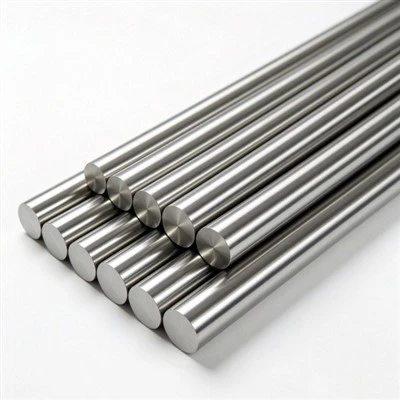
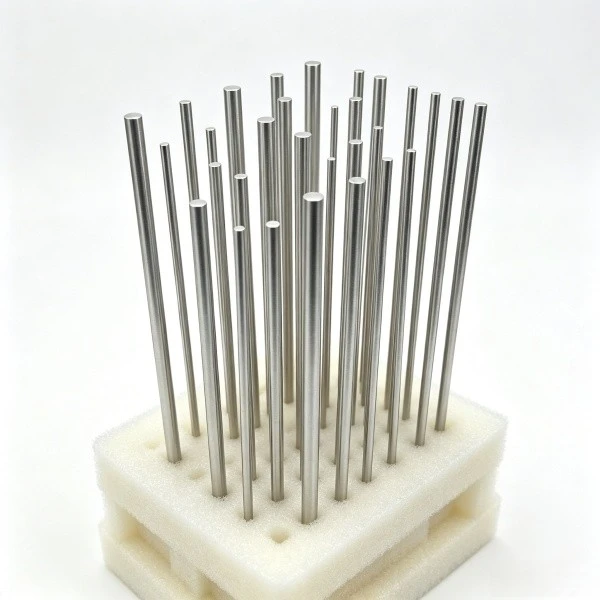


Implant Titanium Rod Description
When an orthopedic implant manufacturer buys titanium rod, they're not really buying metal. They're buying something that cannot fail. That rod becomes a hip stem, a spinal rod, a trauma screw. It goes into a human body and stays there for fifteen, twenty years. If something goes wrong, a return isn't the solution.
So we're not going to use words like "high quality" or "guaranteed." We'll tell you what we can prove. Ti-6Al-4V ELI Extra Low Interstitial Orthopedic Implant Titanium Rod is what we make. Here's how we make it, and why implant manufacturers keep coming back.
How do you guarantee batch-to-batch consistency
The biggest risk with Grade 23 ELI isn't out-of-spec chemistry. It's variation between batches. One heat comes in at 0.10% oxygen, the next at 0.125%. Both pass the chemistry certificate. But they don't machine the same way. They don't fatigue the same way. For an implant machine shop, this is the nightmare - same program, two batches, different tool life and different surface finish.
Our approach: every heat is controlled to 0.10%–0.12% oxygen, not running against the 0.13% limit. Iron is held under 0.20%, not against the 0.25% limit. The margin isn't for looks. It's to keep mechanical properties and machinability inside a narrow band, batch after batch.
|
Element |
ASTM F136 Limit |
Our Internal Control |
|
Oxygen |
0.13% |
0.12% |
|
Iron |
0.25% |
0.20% |
|
Nitrogen |
0.05% |
0.03% |
|
Hydrogen |
0.012% |
0.010% |
This internal control is written into our process documents. Not a verbal promise. If you want to audit it, come audit it.
Can your quality system survive an audit
Implant manufacturers get audited from three directions: their own quality department, their notified body (CE), and the FDA. When the audit reaches the material supplier level, they're not looking for a certificate. They're looking for a chain.
What we provide:
Every lot ships with a Mill Test Report (MTR). Heat number traces back to the original titanium sponge melt. EN 10204 3.1 is standard. 3.2 with third-party witness is available - SGS, BV, TÜV, your choice.
Mechanical properties aren't a single number on a summary sheet. Tensile, yield, elongation, reduction of area - raw test records per heat. Fatigue data available: S-N curves at 10⁷ cycles, per lot or as typical values.
Microstructure is documented. Grade 23 ELI must meet A1–A9 requirements. We hold grain size at ASTM 6 or finer. Not tested on every lot, but we can arrange it if you need it.
Ultrasonic inspection is available. Internal defects in large diameter bar - voids, inclusions - are where fatigue cracks start. We test per GB/T 40324 or ASTM E2375. Report ships with the material.
If you're running an ISO 13485 system, our documents can drop straight into your incoming inspection records. No reformatting needed.
What makes you different from other suppliers
Direct question. We're not the only titanium rod supplier.
First, we do medical grade. We don't do "industrial grade that also works for medical." There are suppliers selling ASTM B348 commercial bar as medical grade. The chemistry looks close. The price is lower. But B348 allows 0.20% oxygen. F136 allows 0.13%. That's not "close." That's two different materials. B348 won't pass regulatory submission for an implant. We don't go near that line.
Second, we control the process, not just the result. Many suppliers test after production and ship what passes. We control oxygen at melting, grain size at forging, deformation at rolling. Final inspection just confirms nothing drifted. Result control is screening. Process control is stability. Implant manufacturers need the latter.
Third, small batches and large batches behave the same. Many mills do fine on small orders and drift on volume. Our process parameters don't change with order size. Your first 50kg order and your fiftieth 500kg order will machine the same way.
Production Route - From Sponge to Implant Rod
Every rod we ship follows the same chain. Nothing gets skipped. Here's what happens between raw titanium sponge and the certified rod that lands at your dock.
|
Step |
What Happens |
Why It Matters |
|
Titanium sponge |
Kroll process from rutile or ilmenite ore |
Base material. Chemistry starts here. Sponge quality determines the ceiling for everything downstream. |
|
Pizza electrode |
Sponge pressed into disc shape, welded into a consumable column |
Electrode density and weld quality affect arc stability during melting. |
|
Smelting |
Vacuum arc remelting (VAR), often double or triple melt |
Removes volatile impurities. Homogenizes chemistry. Multiple melts reduce segregation. |
|
Forging |
Hot deformation of the ingot |
Breaks up cast structure. Closes porosity. Refines grain size. This is where the alpha-beta structure starts to form. |
|
Rod billet |
Semi-finished bar, cut and conditioned |
Intermediate product. Surface defects are ground out before rolling. |
|
Hot rolling |
Controlled temperature and reduction ratio |
Shapes the billet to near-final diameter. Uniform deformation through the cross-section is the goal. |
|
Pickling |
Acid bath removes oxide scale |
Also exposes surface defects so they can be caught before machining. |
|
Machining |
Turning or centerless grinding to final diameter |
Achieves the ISO 286-2 tolerance you specified. Straightness corrected here. |

After machining, if the order calls for polished surface, it goes through final polishing. If ground surface is sufficient, the process ends at machining. The rod is then inspected, tested, and packaged with its full document package.
Every step carries the heat number forward. That's how the rod in your hands can be traced back to a specific sponge batch. That's how Ti-6Al-4V ELI Extra Low Interstitial Orthopedic Implant Titanium Rod earns its paperwork.
Implant machining is mostly Swiss-type lathes and CNC turning. Rod diameter tolerance and straightness directly affect bar feed stability and tool life.
We supply diameter tolerance per ISO 286-2 - h6, h7, h8, h9. Swiss machining typically uses h7. Precision instruments use h6. Straightness held within 0.2mm per 1000mm. Centerless ground is the default process. Surface finish Ra ≤ 0.4μm.
If you're making cannulated screws or instruments with a center hole, concentricity is the critical dimension. We can supply to your concentricity requirement - send the drawing.
Thread rolling instead of cutting - you know this better than we do. Rolling demands tighter diameter consistency. If diameter varies more than 0.03mm, thread height comes out uneven. Our rod won't give you that problem.
Typical applications and matching grades
Spinal rods: 5.0–6.5mm, Grade 23 ELI. Fatigue life is the key spec - 5 million cycles under ASTM F1717. Surface scratches or laps are crack initiation sites. Not acceptable.
Hip stems: 25–50mm blanks. Loads at 4–5 times body weight, a million cycles per year. Oxygen control matters most here. Inclusion size directly affects fatigue life.
Trauma screws: 2.0–8.0mm. Rolled threads, high torque. Rod diameter consistency determines thread quality.
Dental implant fixtures: 3.0–6.0mm. Precision ground rod. Tightest diameter tolerance. Surface quality affects osseointegration.
Surgical instruments: Drill shafts, guide pins, broach handles. Repeated autoclaving. No deformation allowed.

FAQ
Can you supply dual-certified ASTM F136 and ISO 5832-3?
Yes. The chemistry and mechanical requirements are essentially the same. Documents can be issued for whichever market you're filing in.
Can oxygen content be controlled to a customer-specified value?
Yes. If your process requires oxygen in a narrow band like 0.10%–0.11%, tell us upfront. We adjust at the melting stage.
Do you provide third-party test reports?
Yes. SGS, BV, TÜV can be arranged. Cost depends on scope. Typical scope is chemistry verification and mechanical re-test.
How fast can I get a sample?
300mm sample. You pay shipping. Material is free. Credit back on first production order over $10,000. Stock sizes ship in 7–10 days.
why choose us

why choose our products
Not because we're the cheapest. Medical grade titanium rod has a price floor. Below that floor, you're either getting industrial grade sold as medical, or process control steps have been skipped.
Because what you receive and what you ship are produced under the same standard. When your customer audits your supplier, you hand them our documents. When your machining line runs our rod, tool life and surface finish don't shift between batches. When you file with ASTM F136, we provide the full document set that goes with it.
That's what we're here to do. That's what Ti-6Al-4V ELI Extra Low Interstitial Orthopedic Implant Titanium Rod is supposed to be.
Contact
For a quote or sample, tell us grade, diameter, length, quantity, surface finish, and any certification requirements. We reply within 24 hours.
Email: kristy@mt-titanium.com
WhatsApp: +86-17391509251
Hot Tags: ti-6al-4v eli extra low interstitial orthopedic implant titanium rod, China ti-6al-4v eli extra low interstitial orthopedic implant titanium rod manufacturers, suppliers, factory, Biocompatible Titanium Rod for Surgical Implants, High Strength Medical Titanium Rod for Prosthetics, Medical Titanium Alloy Rods for Orthopedic Screws, medical titanium rod, Ti 6Al 4V ELI Medical Rod for Pediatric Orthopedics, Trauma Surgery Support Titanium Rod Medical Grade