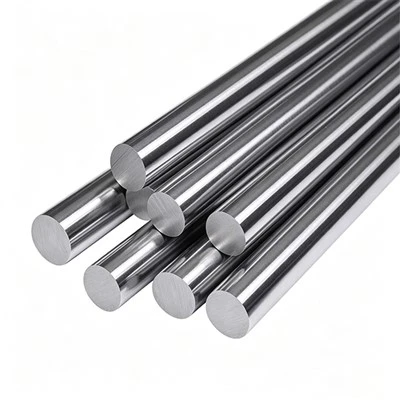


Implant Grade Titanium Rod description
We make implant-grade titanium alloy rods for trauma orthopedic machining. We stick to real ASTM F136 Ti‑6Al‑4V ELI, not standard Grade 5 stock that's just tagged as medical. It has tighter chemistry controls, full traceability, and every batch machines the same way.
Why ELI and Not Commercial Grade 5
Trauma implants - bone screws, locking plates, intramedullary nails, cannulated screws - are machined from ELI for a reason. Oxygen is capped at 0.13% and iron at 0.25%. Commercial Grade 5 allows 0.20% and 0.30%.
That gap shows up at the thread root. Fatigue cracks start at inclusions and surface defects. Fewer inclusions means cracks start later. A trauma screw cycles under load for months while the bone heals. That's where the difference between ELI and B348 stops being academic.
ASTM F136 is the spec that makes the material implant-grade. No F136 certification, no implant material. Simple as that.
|
Property |
Grade 23 ELI (ASTM F136) |
|
Tensile (min) |
860 MPa |
|
Yield (min) |
795 MPa |
|
Elongation |
≥10% |
|
Reduction of Area |
≥25% |
|
Oxygen (max) |
0.13% |
|
Iron (max) |
0.25% |
Grade Comparison - ELI vs Grade 4 vs Commercial Grade 5
Trauma machining uses two implant grades and avoids a third.
|
Property |
Grade 23 ELI (F136) |
Grade 4 CP (F67) |
Commercial Gr5 (B348) |
|
Tensile (min) |
860 MPa |
550 MPa |
895 MPa |
|
Yield (min) |
795 MPa |
483 MPa |
828 MPa |
|
Elongation |
≥10% |
≥15% |
≥10% |
|
Fatigue resistance |
High |
Moderate |
Good, but higher inclusion risk |
|
Machinability |
Slower speeds, carbide required |
Faster feeds, longer tool life |
Similar to ELI |
|
Implant approved |
Yes |
Yes |
No |
|
Typical trauma use |
Bone screws, nails, plates |
Drill guides, trials, instruments |
Not for implants |
ELI carries the load. Bone screws, intramedullary nails, locking plates. 860 MPa tensile and high fatigue resistance are what a trauma implant needs.
Grade 4 CP handles the non-load-bearing side. Drill guides, instrument shafts, trial components, some fixation plates. It machines faster and wears tools less. A shop making thousands of drill guides saves real money on tooling with Grade 4.
Commercial Grade 5 isn't implant material. ASTM B348 allows 0.20% oxygen. F136 allows 0.13%. Two different materials with different fatigue performance. B348 won't pass implant submission. We don't sell it for trauma work.
The rule is simple. Load-bearing and goes into the patient: ELI. Instrument or trial: Grade 4 CP. Someone offering B348 as implant material: walk away.
Our Products


Machinability - What Actually Changes
|
Parameter |
Grade 23 ELI |
Grade 4 CP |
|
Cutting speed |
30–60 m/min |
60–90 m/min |
|
Tool material |
Carbide, sharp edges |
Carbide, standard geometry |
|
Work hardening |
Pronounced - keep the tool moving |
Less pronounced |
|
Coolant |
Flood required |
Flood recommended |
|
Threading |
Rolling preferred over cutting |
Rolling or cutting both work |
|
Tool life |
Shorter on high-volume runs |
Longer, fewer tool changes |
ELI's work-hardening behavior is the thing that bites. If the tool rubs instead of cuts, the surface hardens and the next pass gets harder. Sharp tools, high feed, flood coolant - none of that is optional. On a Swiss lathe running thousands of bone screws, tool changes add up fast.
Grade 4 is more forgiving. Higher speeds, longer tool life, fewer interruptions. On instrument production, that's lower cost per part.
Applications and Matching Grades
Bone screws: ELI, 2.0mm to 8.0mm. Cortical and cancellous. Rolled threads for fatigue strength. Bar must be straight and consistent.
Intramedullary nails: ELI, 8.0mm to 15.0mm. Cannulated for guide wire. Long and slender - bar straightness is critical.
Locking plates: ELI, machined from plate or bar depending on design. High fatigue requirement.
Cannulated screws: ELI, 3.5mm to 7.3mm. Guide wire through the center. Precannulated bar cuts machining steps.
Drill guides: Grade 4 CP, 3.0mm to 10.0mm. Non-load-bearing. Machinability matters more than strength.
Trial components: Grade 4 CP. Sizing during surgery. Not implanted. Cost and machinability drive the choice.
Instrument shafts: Grade 4 CP. Reusable. Autoclavable. Corrosion resistant.
Documentation and Traceability
Every lot ships with a Mill Test Report. Heat number, chemical analysis, mechanical properties. Traceable back to the original sponge melt.
EN 10204 3.1 is standard. 3.2 with third-party witness available for FDA 510(k) or CE submissions. SGS, BV, TÜV - your pick.
For ISO 13485 systems, the documentation package links each finished implant to the material lot it came from. No gaps. When your auditor asks for traceability on a production lot, you hand over the file.
The FDA recognizes ASTM F136 as a consensus standard for surgical implants. When you file with F136, our material certification becomes part of your submission.
Customization and Cut-to-Length
Standard diameters 3.0mm to 30mm. Up to 50mm on request.
Cut from 500mm to 3000mm. Send a cut list and the bar arrives deburred and packaged for your Swiss lathe.
Diameter tolerance per ISO 286-2. h7 standard for trauma work. h6 for small-diameter cannulated screws where feed consistency is critical.
Surface: centerless ground (Ra ≤ 0.4μm) for standard machining, polished (Ra ≤ 0.2μm) for fatigue-critical surfaces, turned for rough blanks.
Precannulated bar on request. Inner diameter, outer diameter, concentricity - tell us what you need.
FAQ
Q: What diameter tolerance do trauma machinists typically need?
A: h7 is standard for Swiss machining. h6 for high-precision cannulated screws and small-diameter bone screws where bar feed consistency is critical.
Q: Why not use commercial Grade 5 to save cost?
A: ASTM B348 Grade 5 allows 0.20% oxygen and 0.30% iron. F136 ELI caps them at 0.13% and 0.25%. More interstitial content, more inclusions, shorter fatigue life. B348 also fails implant regulatory submission.
Q: What documentation comes with the bar?
A: MTR with heat number, chemical analysis, mechanical test results, ASTM F136 or F67 certificate.
Q: Lead time?
A: Stock sizes 7–10 days. Custom diameters or lengths 15–35 days depending on quantity.
Why This Bar Works?

Trauma machining doesn't tolerate inconsistent material. A screw that fails at the thread root is a revision surgery. A nail with uneven walls is a clinical problem.
Implant Grade Titanium Rod for Trauma Orthopedic Machining ships with the tolerances, surface condition, and paperwork that trauma production requires. ELI for load-bearing implants. Grade 4 CP for instruments and trials. F136 and F67 certification. Full traceability.
If your shop machines trauma implants, you already know what happens when the bar isn't right. We supply bars that don't cause that problem.
Contact
Need a quote on Implant Grade Titanium Rod for Trauma Orthopedic Machining?
Tell us grade, diameter, length, quantity, surface finish, and whether you need solid or precannulated bar. We'll reply within 24 hours.
Email: kristy@mt-titanium.com
WhatsApp: +86-17391509251
Hot Tags: implant grade titanium rod for trauma orthopedic machining, China implant grade titanium rod for trauma orthopedic machining manufacturers, suppliers, factory, Biocompatible Titanium Rod for Surgical Implants, Medical Alloy Wire with Controlled Diameter, Medical Titanium Sheet with Controlled Thickness, Ti 6Al 4V ELI Medical Rod for Pediatric Orthopedics, Titanium Alloy Rods Comply With The ASTM F67 Standard, Titanium Stock for Orthopedic Implant Forging