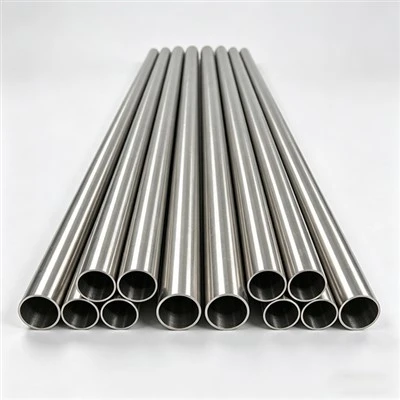


What it is
Industrial reactors mix chemicals under pressure and heat. Inside the reactor, things get corrosive. Acid. Chlorides. Caustic. The reactor shell is thick plate. But internal components need tubes.
Large diameter titanium tube for industrial reactors goes inside. Sparger tubes. Dip tubes. Heat exchanger tubes. Agitator shafts. Any tube inside a reactor that sees corrosive fluid.
Steel tubes rust. Stainless pits. Titanium tubes last.
Why titanium inside reactors
Inside a chemical reactor, conditions are aggressive. High temperature. High pressure. Corrosive chemicals.
Titanium handles it. Oxide layer protects. No rust. No pitting. No contamination of the reaction.
For large diameter titanium tube for industrial reactors, the tube is not the reactor shell. It's the internal piping. Spargers distribute gas. Dip tubes withdraw liquid. Internal heat exchangers.
Which grade for reactor internals
| Grade | Best for | Key feature |
| Grade 2 | General chemical service | Best all-around |
| Grade 12 | Hot brine, crevice conditions | Added Mo + Ni |
| Grade 7 | Hot acids, wet chlorine | Added palladium |
Grade 2 covers most reactor applications. Dilute acids. Chlorides. Moderate temperature.
Grade 12 for hot brine or where crevice corrosion is a concern.
Grade 7 for aggressive hot acids.
Material specs (Grade 2)
| Property | Value |
| Tensile (min) | 345 MPa |
| Yield (min) | 275 MPa |
| Elongation | ≥ 20% |
| Density | 4.51 g/cm³ |
| Max temp | 300°C |
Large diameter sizes for reactors
| OD (mm) | Wall (mm) | Typical use |
| 100 – 150 | 2.0 – 4.0 | Sparger tubes |
| 150 – 200 | 3.0 – 5.0 | Dip tubes |
| 200 – 250 | 4.0 – 6.0 | Internal heat exchangers |
| 250 – 300 | 5.0 – 8.0 | Agitator shafts |
| 300 – 400 | 6.0 – 10.0 | Large spargers |
| 400 – 500 | 8.0 – 15.0 | Custom internals |
Where it goes
-
Sparger tubes. Distribute gas into liquid. Holes along the tube. Must not corrode. Clogging from corrosion products ruins sparging. Grade 2. 100mm to 200mm OD.
-
Dip tubes. Liquid withdrawal from reactor. Long tube reaches bottom. Corrosive liquid flows through. Grade 2. 150mm to 250mm OD.
-
Internal heat exchangers. Coils or tubes inside reactor. Cool or heat the reaction. Thin wall. 2mm to 4mm. Grade 2 or Grade 12.
-
Agitator shafts. Mixing. Tube acts as shaft. Large diameter. Thick wall. High strength. Grade 5 or Grade 2.
For large diameter titanium tube for industrial reactors, the tube is custom fabricated. Welded. Drilled. Mounted inside the reactor.
Sparger tubes
Gas spargers inject gas into liquid. Air. Oxygen. Nitrogen. Chlorine.
The sparger sits in corrosive liquid. Holes can be small. If the tube corrodes, holes plug with rust.
Titanium spargers don't corrode. Holes stay open. Gas distribution stays uniform.
For large diameter titanium tube for industrial reactors, Grade 2 spargers are common.
Dip tubes
Dip tubes reach from the top of the reactor to near the bottom. Liquid is withdrawn through the tube.
The tube sees the full chemistry of the reactor. Corrosive. High temperature.
Titanium dip tubes outlast steel by years.
Welding large diameter titanium tube
Titanium welding requires argon shielding. Inside and outside. Large diameter tubes need more planning.
Back purge is critical. For a 300mm tube, you need to seal the ends. Fill with argon.
Use ERTi-2 filler for Grade 2. ERTi-5 for Grade 5.
For large diameter titanium tube for industrial reactors, weld quality is inspected. Dye penetrant. X-ray.
Why not stainless inside reactors
Stainless steel 316L works in some reactors. But in chlorides, it pits. In reducing acids, it corrodes.
When stainless pits, the pit grows. Tube wall thins. Leaks.
Titanium doesn't pit. Not in chlorides. Not in most acids.
For large diameter titanium tube for industrial reactors, titanium is the safe choice.
Cost vs performance
Stainless steel tube is cheaper. But if it fails in two years, you pay for replacement. Reactor downtime. Lost production.
Titanium tube costs more upfront. Lasts 10-20 years. Less downtime.
For large diameter titanium tube for industrial reactors, the total cost is often lower with titanium.
Fabrication considerations
Cutting. Plasma or waterjet. Bevel ends for welding.
Drilling holes. For sparger tubes. Hundreds of holes. Clean. No burrs.
Flanging. Bolt connections to reactor nozzles.
We supply tube as-welded or pickled. Fabrication done by reactor manufacturer.
Testing and certification
Hydrostatic test. Mill test reports. Heat number traceable. ASTM B861 or B862 cert.
Third-party inspection available.
FAQ
Q: Grade 2 or Grade 12 for a dip tube in hot brine?
A: Grade 12. Hot brine is aggressive to crevices. Grade 12 resists better.
Q: What wall thickness for a 200mm sparger?
A: Depends on pressure. Typical 3-5mm. No corrosion allowance needed.
Q: Can I use Grade 5 for a sparger?
A: Yes but overkill. Grade 2 is cheaper. Easier to weld. Grade 2 corrosion resistance is the same.
Q: How do you weld a large titanium tube inside a reactor?
A: Field welding is possible but difficult. Requires argon purge. Prefer shop fabrication of complete spool.
Q: Lead time?
A: Stock sizes 4-5 weeks. Non-stock 8-10 weeks.
Q: Sample tube?
A: Yes. 300mm sample. Pay shipping. Material free.
The bottom line
Inside industrial reactors, conditions are corrosive. Steel fails. Stainless pits.
Large diameter titanium tube for industrial reactors survives.
Grade 2 for most chemicals. Grade 12 for hot brine. Grade 7 for hot acids.
Sparger tubes. Dip tubes. Internal heat exchangers. Agitator shafts.
Large diameter. Thick wall. Welded or seamless.
Lasts years inside the most aggressive reactors.
Contact
Need a quote on large diameter titanium tube for industrial reactors? Tell us grade, OD, wall thickness, length, quantity, and application (sparger, dip tube, etc.). We'll reply within 24 hours.
Email: kristy@mt-titanium.com
WhatsApp: +86-17391509251
Hot Tags: large diameter titanium tube for industrial reactors, China large diameter titanium tube for industrial reactors manufacturers, suppliers, factory, Corrosion Resistant Titanium Tube for Petrochemical Industry, Large Diameter Titanium Tube for Industrial Reactors, Thin Wall Titanium Tube for Automotive Exhaust Systems, Titanium Alloy Tube for Aerospace Hydraulic Systems, titanium tube, Titanium Tube ASTM B338 Industrial Standard